
🔥Any work on the injection system can only be carried out on a cold engine 🔥
The pump requires a fuel pressure regulator manufactured at least in 246 09, the year of manufacture is on the regulator housing, these are the last two digits in the third row, e.g. 10 is 2010. New GM regulators, after regeneration or new F5R, do not require checking the production date. The installation of a pump in a system with an older regulator is only possible under the responsibility of the user and any damage to the pump is not covered by the warranty in this case.
After removing the old pump, move the black plastic washer to the new pump. Unscrew the intake terminal from the old pump and screw it to the new pump. (there is a new O-ring inside the cap, if the old one is in poor condition). Check condition of the fuel filter inside the intake terminal. It is recommended to disconnect the fuel line from the connector because it is easier to screw the connector to the pump. After lubrication, the connector is screwed in with your fingers and only tightened with a wrench.
During installation, please bear in mind that petrol is a solvent, so you must remove any petrol from the regulator socket and then apply lubricant to both the socket and the regulator.
Screw the new pump to the engine (10Nm) and then the steel pipe between the rail and the pump (25Nm, sometimes it is necessary to bend the pipe slightly to make it fit the pump). If the fuel rail is empty, first fill the rail with fuel. Loosen the steel line on the pump connector and turn the ignition on several times. Then the fuel rail will be flooded and the air will be forced out of it.
Do not start the engine when the fuel rail is empty.
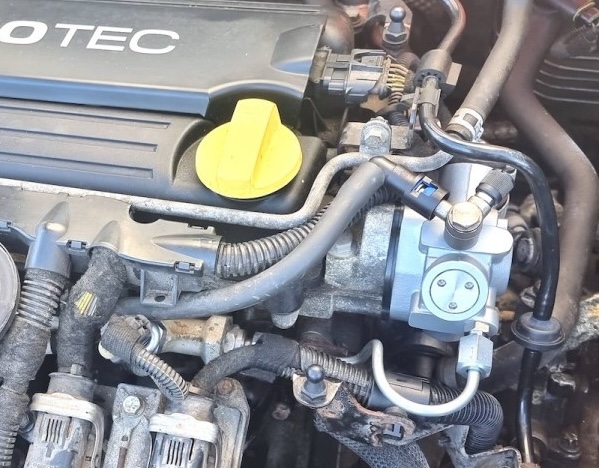
Start the engine and check for leaks.
If not, drive at least 50-100 km to vent and adapt the injection system, try to reach several times 4000-5000 rpm for a short period of time . If a fault occurs while driving, restart the engine and continue driving. After cooling the engine and restarting, a fault may also appear. There is a normal venting process for the injection system.
For the first 1000 km do not turn the engine above 3000 rpm for a long time due to lapping shaft slide bearings and section slips. Over the next 1000 km do not turn over 4000 rpm. Failure to do so may cause overheating of the slides and damage to the pump.
In the event of the injection fault in the initial period of operation, it is recommended to accelerate several times in second gear up to 4000-5000 rpm.
Do not run the engine with a disconnected fuel pressure regulator.
Never completely block the pump outlet during operation.
Do not speed up the engine to the red line without a load.
If you remove the pump from the engine, you must cap all fuel terminals
*For Opel Zafira, make sure the ffactory fuel filter is fitted under the floor, if not, the fuel filter must be fitted to the fuel line from the tank. (Some Zafira models do not have a factory fuel filter)
* According to the service manual, after removing the pump or regulator, all openings in both the rail and the pump must be plugged. Do not leave the injection system open (parts dry out completely very quickly, which can lead to the injectors or pump seizing when attempting to start them, and can also cause corrosion of steel components).